Thursday, December 28, 2023

The Session (Carbondale)

UPDATE:  On April 3, 2025, WSIU removed most of my Session videos from YouTube for broadcast and copyright reasons.  The videos I posted were originally given to my by Bruce Scafe, creator and producer of the show, who specifically asked that I share them.   Thankfully, most of the videos posted here were already available elsewhere.

2nd UPDATE (May 27, 2026):  WSIU assures me that the original master tapes for the Session are safely stored on the Carbondale campus.  They hope to re-air some of the episodes as money and time allows.  In fact, they plan to rebroadcast the complete Billy Joel show during the upcoming pledge drive.

The Session, one of the first nationally televised music programs to feature up-and-coming artists, was filmed and produced by WSIU-TV (Channel 8) in Carbondale, Illinois.  The half-hour show aired weekly on PBS stations across the country between 1971 and 1973.  It featured primarily rock, jazz and folk groups from downstate Illinois as well as the St. Louis area.  On occasion the show presented new artists from around the country, including a young "Piano Man" from New York.

The Session was the brainchild of Bruce Scafe, WSIU's television producer at the time.  Scafe was an Aurora, Illinois native that held a bachelor's degree in music and a master's in radio-television from the University of Illinois.  Before being hired at WSIU in 1970, Scafe played trumpet for two years in Les Elgart's band.  He was also a member of the U of I Jazz Band for several years.  The Session was a natural marriage of Scafe's two main interests, music and television.

Between August 1971 and August 1972, Scafe directed and produced 67 episodes of The Session.  All of the camera and audio crew were students at Southern Illinois University.   Hosts of the show included London Branch, Larry James and David Langdon. 

Initially the program was broadcast in Carbondale and re-shown on public television networks around the Midwest.  By the summer of 1973, PBS selected 17 programs to broadcast nationally.  Before they aired however, Scafe left WSIU for a television job in Texas.

When asked about the show in 1973 for a syndicated article promoting the program, Scafe said, "We only had two cameras available.   It would have looked great if we had three.  I look at the program now and I find a lot that's lacking."  He added, "But we did the best we could and I think we actually pulled off miracles with the equipment we had."  

A year later, Scafe went on to help create another music show for public television in Texas.  That show, now the longest-running music program in television history, was Austin City Limits.  In a recent correspondence with Bruce Scafe, he reflected on his time directing and producing The Session more positively than he did in 1973, saying "Everything I learned about directing music came from that show.  I had to be quick on my feet.  With only 2 cameras I had to make every shot count and be able to anticipate what was next.  I think we accomplished that…making 2 cameras look like 3.”  Scafe added, "I can honestly say there would be no ACL without that experience."

Thanks to Bruce, we can now watch more episodes of The Session than any time in the last 50 years.  He has shared with us several complete episodes which you will find below.  Also, Bruce has shared a treasure trove of photographs taken by Myers Walker, art director at SIUC-TV at the time.  Walker was responsible for the variety of different sets used on The Session.  His photographs provide a unique view of the show and the musicians.   The descriptions below come directly from the PBS press releases and/or newspaper TV listings.

The Session - Performers and Episodes

Brownsville Station  (PBS Ep. 101 / Tape Date: ? /  Air Date: 6/9/73)

You may be able to view the video HERE

Recorded in Carbondale, Illinois in 1972 and aired nationally by PBS in June of 1973.   The band members included:  Tony Driggins (bass), Michael Lutz (vocals, rhythm guitar), Henry Weck (drums) and Cub Koda (lead guitar).  The Session was produced and directed by Bruce Scafe.  The songs performed: 

Mister Robert
Wanted (Dead or Alive)
Rock With The Music
Jonah’s Here To Stay
Country Flavor


Fanny  (PBS Ep. 102 / Tape Date: ? / Air Date: 6/16/73)
 Recorded in Carbondale, Illinois sometime in 1972 and aired nationally on PBS in June of 1973. 0:00 Knock On My Door 5:37 Hey Bulldog 9:48 Ain't That Peculiar 14:14 The First Time 18:47 Borrowed Time 22:31 Charity Ball Below is the original PBS press release:
Fanny, an all-girl rock band who write, sing and play today's music will perform on "The Session," a new summer series of rock and jazz programs produced by public television station WSIU, Carbondale, Illinois. With four albums to their credit, Fanny has toured extensively throughout the United States and Europe where they are well-known. A hit single, "Charity Ball," put the group at the top of the charts. Of the group, two Manilla born sisters, Jean and June Millington play bass and guitar respectively, with Nicoel Barclay on organ and piano and Alice deBuhr on drums. Nicoel (Nickey) does most of the song-writing for the group. For "The Session" the group does several numbers from their third album, "Fanny Hill," including "Knock on My Door," "Hey, Bulldog," "First Time," "Ain't that Peculiar" and the aforementioned hit, "Charity Ball."
"The Session" is a production of WSIU, Carbondale, Illinois. Dave Langdon is host, produced and directed by Bruce Scafe. The program is transmitted nationally by PBS, the Public Broadcasting Service.
 
    
Fanny, an all-girl rock band who write, sing and play today's music will perform on "The Session," a new summer series of rock and jazz programs produced by public television station WSIU, Carbondale, Illinois. With four albums to their credit, Fanny has toured extensively throughout the United States and Europe where they are well-known. A hit single, "Charity Ball," put the group at the top of the charts. Of the group, two Manilla born sisters, Jean and June Millington play bass and guitar respectively, with Nicoel [sic] Barclay on organ and piano and Alice deBuhr on drums. Nicoel (Nickey) does most of the song-writing for the group. For "The Session" the group does several numbers from their third album, "Fanny Hill," including "Knock on My Door," "Hey, Bulldog," "First Time," "Ain't that Peculiar" and the aforementioned hit, "Charity Ball."
John Hicks Quartet  (PBS Ep. 103 / Tape Date: ? /  Air Date: 6/23/73)
Besides being an excellent jazz pianist, John Hicks does a great deal of composing and arranging. He is joined by Julius Hemphill on alto sax and flute, Gerald Brantley on bass, Phillip Wilson on drums, and Marcella Hooks, vocalist.

Mike Murphy and the One-Eyed Jacks  (PBS Ep. 104  Tape Date: ?  Air Date: 6/30/73

    
Mike Murphy and the One Eyed Jacks, a rock group with a good measure of rhythm and blues in their act, will be featured on The Session. Group leader Mike Murphy does all of the song writing for the One Eyed Jacks and plays a total of 13 insturments, including calliope, accordion, French horn and of course guitar. Through the years Murphy has played with such rock superstars as Janis Joplin, the Jefferson Airplane, Blood, Sweat & Tears and many others. Other players in the group are: Van Gray, congas; Terry Murphy, organ; Bruce Hall, bass; and Greg Sagesser, drums. For The Session, Mike Murphy and the One Eyed Jacks perform "You Don't Seem to Realize," Untitled," "You've Got Your Nerve," "La La Song," all Mike Murphy tunes and Burt Bacharach's "The Look of Love."

Don Crawford  (PBS Ep. 105  Tape Date: 3/22/72  Air Date: 7/7/73)
Folk-rock singer Don Crawford will appear on "The Session," the PBS series of popular music. Crawford, a native of San Francisco is known as a singer of folk songs, rhythm and blues oriented music and is also an actor, monologist and composer. A professional performer since the age of 14, he is adept at six and twelve string guitar and is an accomplished jazz bassist. Among others, he has performed with musicians John Handy, Paul Horn and Gerald Wilson. For "The Session," Crawford performs "I I See You Inside My Mirror," "The Colorado Sweet / Suite," "Gonna Buy You A Music Box," "Lady Anne," "4th Of July Party Song," "For All The Ladies," and "All Because Of You."

Burton & Cunico  (PBS Ep. 106 / Tape Date: ? / Air Date: 7/14/73)

Ray Burton and Gino Cunico, a folk-rock duo from Sydney, Australia, on WSIU-TV's The Session. The program was taped in 1972 in Carbondale, Illinois and aired nationally in July of 1973. Hosted by Larry James, the Session was produced and directed by Bruce Scafe. The songs performed: Gypsy Lady How In Love Am I? Astral Plane Ride Grandfathers (I Live In A) World Of Fantasy Dream For A Love Run For Your Life
Jake Jones  (PBS Ep. 107 / Tape Date: 5/3/72 / Air Date: 7/21/73)
"a rock band whose instruments include a mellotron"

Recorded May 3, 1972 in Carbondale, Illinois and aired nationally on PBS in July of 1973.  The band included Chuck Sabatino (bass, vocals), Joe Marshall (guitar), Phil Jost (keyboards, mellotron) and Don "Barney" Biver (drums).   The Session was directed and produced by Bruce Scafe.  Some of the songs performed:

The Boat Song
Kiss of Death
Why Do I Cry
Speak To Me Lady
Don't Let Lost Time Bring You Down

Gerry Grossman  (PBS Ep. 108 / Tape Date: ? / Air Date: 7/28/73)

Gerry Grossman, a singer-guitarist-comic from Chicago, will perform on The Session. Twelve years of guitar experience, plus an extensive knowledge of rock n' roll all the way back to the Big Bopper, provide Grossman with an impressive repertoire. He is continually called upon to defend his claim that he can perform ninety-five percent of all pop songs recorded since 1955. Comedy figures prominently in Grossman's act as well. During a performance he parodies the subjects that are amusingly close to us all - pop music, television, social customs and adolescence. Grossman has appeared at many clubs in the Midwest and has performed on college campuses across the country. For The Session Grossman sings "Rock n' Roll Medley," "When She Smiled," "I Found You," "Watching the World Go By" and "Christy."


Dub Crouch, Norman Ford, and the Bluegrass Rounders  (PBS Ep. 109 / Tape Date: ? / Air Date: 8/4/73)

Dub Crouch, Norman Ford and the Bluegrass Rounders, a veteran bluegrass group from St. Louis will provide a rousing program of entertainment on The Session. The group has been together for sixteen years, and in 1971, were the winners of both the National and International Bluegrass Band Festival, held in Oklahoma. Along with Dub Crouch, who plays the 5 string banjo, and Norman Ford, who plays the flattop guitar, are Stan Wagganer, mandolin, Bob Wagganer, fiddle and Jesse Sanson, bass fiddle. For their appearance on The Session, the group performs "Panhandle Country," "Midnight Train," "Just A Used-To-Be To You," "Doin' My Time," "Roll On Buddy, Roll On," "Rawhide," "Live and Let Live" and "Ozark Breakdown."


St. Louis Ragtimers  (PBS Ep. 110 / Tape Date: ? / Air Date: 8/11/73)

St. Louis Jazz Quartet  (PBS Ep. 112 / Tape Date: ? / Air Date: 9/8/73)
Formed four years ago, the Quartet has made several appearances with the St. Louis Symphony Orchestra, and has performed more than 200 concerts for the St. Louis Chapter of Young Audiences, Inc., in addition to numerous special concerts on college campuses throughout the Midwest.  Jeanne Trevor is the vocalist for the quartet.  Other members are David Schrage, pianist, Terrence Kippenberger, bass, and Charles Payne, drums.  Their program on THE SESSION will include “I Got Love,” “Green Dolphin Street,” “A House Is Not A Home,” and “Bridge Over Troubled Water.” Mike Murphy and the One Eyed Jacks, a rock group with a good measure of rhythm and blues in their act, will be featured on The Session. Group leader Mike Murphy does all of the song writing for the One Eyed Jacks and plays a total of 13 insturments, including calliope, accordion, French horn and of course guitar. Through the years Murphy has played with such rock superstars as Janis Joplin, the Jefferson Airplane, Blood, Sweat & Tears and many others. Other players in the group are: Van Gray, congas; Terry Murphy, organ; Bruce Hall, bass; and Greg Sagesser, drums.
The Ship  (PBS Ep. 113 / Tape Date: ? / Air Date: 9/15/73)
An unusual folk-rock opera called "The Ship" embarks on a "a voyage through the human emotional range." Authors Steve Melshenker and Steve Cowan - who also perform on the program - describe "The Ship" as a "a contemporary folk music journey, a journey of the mind." Their opera uses a voyage metaphor to involve the listener in "an exploration and penetration of the senses." Segments of the opera are entitled "The Storm," "The Calm," "Lost," and "The Island." Performing "The Ship," which will soon be released by Elektra Records, are Todd Bradshaw, electric bass; Steve Reinwand, guitar, dobro, harmonica and vocals; Mark Hamby, piano, flute and vocals; and composers Melskenker and Cowan, guitar and vocals.

Ron Elliston Trio  (PBS Ep. 114 / Tape Date: ? / Air Date: 9/22/73)

The Ron Elliston Trio - all members of the University of Illinois Jazz Band - are Fred Atwood, bass; Chuck Braugham, drums; and Elliston, piano. Braugham won the "Best Big Band Drummer Award" at the Mobile (Alabama) Jazz Festival in 1969, and the same year was named "Best Drummer" at the Notre Dame Collegiate Jazz Festival. Bassist Fred Atwood has appeared with Phineas Newborn, Jr. and toured with the Maynard Ferguson Band. Elliston appeared with Dick Schory at Carnegie Hall and worked with the Al Cohn - Zoot Sims Quintet. Their program will include "Skating in Central Park" by John Lewis; a medley of Miles Davis' "All Blues," Bach's Prelude in E Minor and "Django" by John Lewis; and "Minha Saudade.


Coal Kitchen  (PBS Ep. 115 / Tape Date: ? / Air Date: 9/29/73)
   
Band members: Carla Peyton, vocals; Kevin Cox, flute and congas; Harry Washburn, guitar; Bob Pina, keyboards; Andre Mossotti, bass; and Billy McMullin, drums

Oliver Lake and BAG (Black Artists' Group)  (PBS Ep. 116 / Tape Date: ? / Air Date: 10/6/73)

Illinois Quartet  (PBS Ep. 117 / Tape Date: ? / Air Date: 11/9/73)
Modern variations on a classical form - the string quartet - are offered by the Illinois Quartet, as they perform two compositions.
There were roughly 50 additional episodes of the Session that aired in Carbondale and around the Midwest in 1971-1972 that were not selected by PBS.   This includes some of the earliest known footage of the "Piano Man."

Billy Joel & Friends  (Tape Date: 2/10/72)
  
 
Billy Joel would just as soon chuck the whole music business, buy a boat and spend the rest of his life fishing. But now that he's in music, he writes all of his own music and displays unusual versatility and range of expression on both his vocals and the piano. Backin up Billy Joel are Al Hurtz on guitar, Larry Impelletiere on bass and Rhys Clark on drums. Numbers include "Travelling Prayer," "Everybody Loves You Now," "Captain Jack" and "Tomorrow is Today."

Listen to a podcast about the Billy Joel & Friends episode which includes an interview with Bruce Scafe:
The Session also featured a number of groups from the Champaign-Urbana rock, folk and jazz scenes:
REO Speedwagon  (Tape Date: 10/13/71)
You may be able to view the video HERE

Head East (Tape Date: 11/12/71)
    "who make use of their Moog-Synthesizer"

Finchley Boys
    "a rock group perform with an electric violin"

Sunday
    "group combines hard rock and jazz music"
  

All Star Frogs

Rocky Maffit
    "Rocky Maffit is a composer-lyricist-singer-guitarist. His music is on the quiet side, but not without a distinctively underlying rhythm and an interesting and unusual blend of voice and guitar. The numbers he performs include 'Gasoline Rainbows,' 'On the Boulevard' and 'Only Suckers Worry'"

James Barton & Friends
    "sing his original folk songs"

Ron Bridgewater Quartet
    "perform 'Naima' and 'Arman,' characterizes its music as the black man's experience through jazz"

Many of the other performers featured on The Session were from southern Illinois or the St. Louis area.

Magna Crunch
    "a six man rock band that blends rock and jazz with choreography and unique musical instruments"
    "a St. Louis rock band plays a program of entirely original music incorporating a wide range of styles from ragtime to an Old English Round"
   

David Earl
     "composer-singer peforms his own work.  Puts his poetry to music"
   

Bob Rembke
    "folk-rock guitarist and comedian presents his own works and some by Bob Dylan"
   

Dalphene McAdory
    "sings in a small nightclub atmosphere"
   

Oldfield, Branch & Company
    "The jazz trio performs four original compositions, plus Simon and Garfunkel's 'Bridge Over Troubled Waters'"
   

Fee


The Singing Sphinx & The Souvenir Sounds
     "The Carbondale, Ill. chapter of the Sweet Adelines of America, who call themselves the Singing Sphinx, combine with their barbershop brothers from Herrin, the Souvenir Sounds, to bring an evening of barbershop harmony."
   

Ed Jenny
    "sings excerpts from his three rock operas"

Spoonriver Band
     "'Funky rock 'n' roll plus a little touch of soul' is one way of characterizing the music of The Spoonriver Band from St. Louis. The varied backgrounds of several of its members presents a tasteful blend of styles"

Frank Bellino 
    "plays the viola d'amore"

Gand Family Singers (Tape Date: 4/12/72)

    "Bob Gand and his daughter Gale and son Gary are joined by Joan Berstein in a  performance of traditional American folk songs"

The Group
    "a small jazz trio"

Rich Crandall Trio
    "a contemporary jazz-rock group"

Stanton, Sullivan & Riley
    "freedom and intense involvement are the cornerstone of this group, a folk trio from Carbondale, Illinois"

Corey Jones
    "guitarist plays folk-rock and bluegrass"

Kay Pace & The Inspirational Wonders 
   "gospel singers from Freewill Baptist Church, Carbondale"

Olive Brown
    "blues singer"

SIU Baroque Ensemble 
    "performs Bach, Handel"

The Riverfront Ragtimers
    "features Jean Kittrel on piano, Don Frantz on banjo and Don Summers on tuba"

London Branch Quartet 

Don Brown & The Ozark Mountain Trio

The Country Sounds

Diamond Rio

Equinox

Vince Huffman Quartet

The Jazz Progression

SIU Faculty Brass Quintet

The Session - Behind The Scenes


The original story was posted in July 2023.  Special thanks to Bruce Scafe for generously sharing videos, photos and documents from The Session. 

Wednesday, December 6, 2023

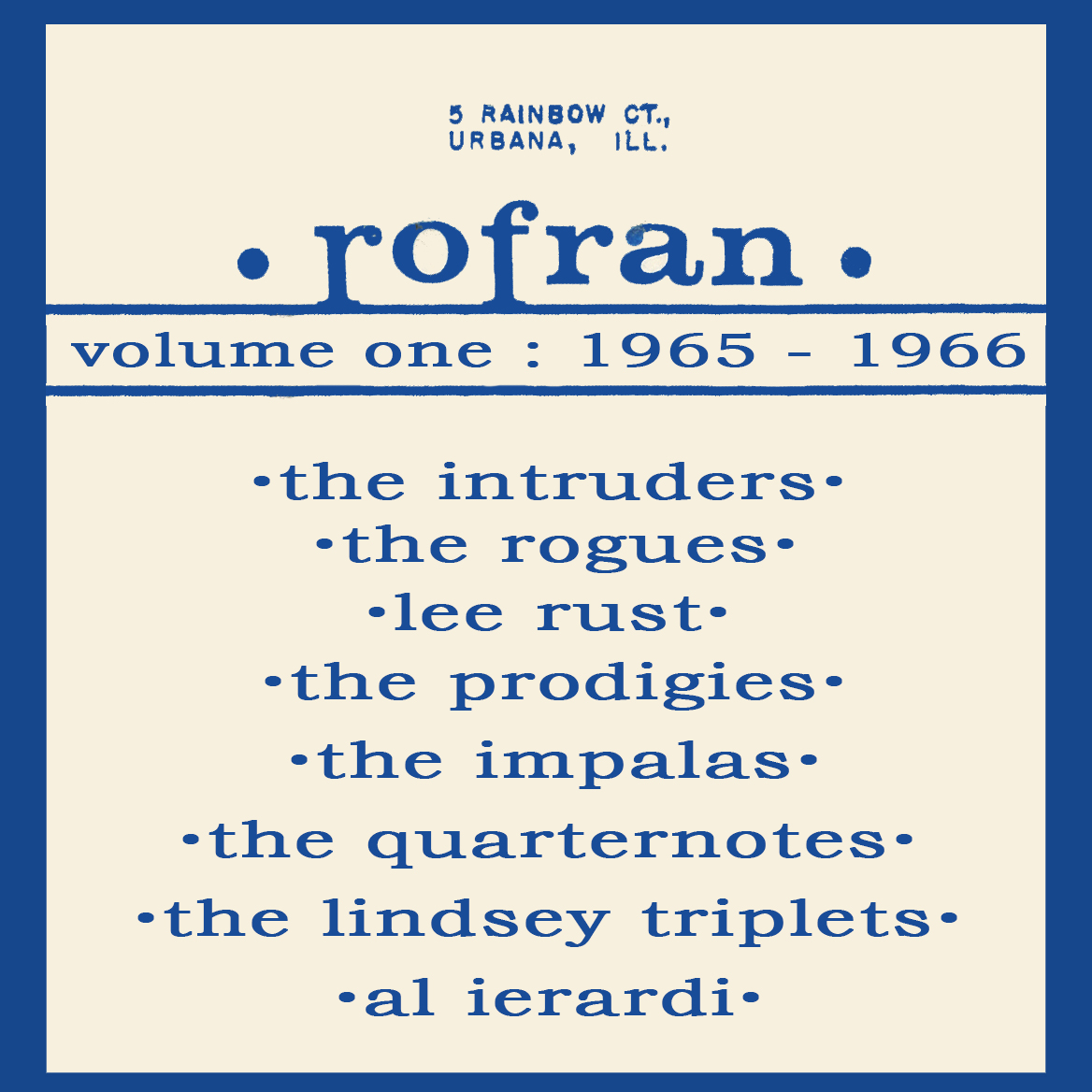
RoFran Records Volume One: 1965-1966

ARTISTTITLEYEAR
The IntrudersDeception1965
The RoguesGone To Stay1965
Lee RustDid You Ever Kind Of Wonder1965
Lee RustMystery House1965
Lee RustTry, Try to Leave1966
Lee RustShe’s Gone Tonight1966
The ProdigiesKysmyph (KIS-MIF)1966
The ImpalasKristina1966
The ProdigiesI Want To Do It1966
The QuaternotesMy Baby Left Me1966
The ProdigiesRudolph The Red-Nosed Reindeer1966
The Lindsey TripletsTomorrow’s Another Day1966
Al IerardiDrifter1966
The IntrudersIntrudin'1965
The RoguesWait Till the Summer1965
Lee RustScramble1965
Lee RustCome on Back1965
Lee RustI’m Spoken For1965
Lee RustWorld Made of Romance1965
The ProdigiesDon’t Look Back1966
The ImpalasLost Beat1966
The ProdigiesWhat’d I Say1966
The ProdigiesSleigh Ride1966
The Lindsey TripletsTerry1966
Al IerardiDureen1966

Friday, November 24, 2023

RoFran Enterprises (Urbana)

SESSIONS LOG -CLICK TO VIEW
RoFran Enterprises was a recording studio and record label owned and operated by Roger Francisco in Urbana, Illinois from 1965 to 1973.

Over the course of those nine years, the studio produced roughly 120 singles, EPs and albums combined, with almost all of them pressed in very small quantities.  The majority of the musicians found on those releases were from downstate Illinois or associated with the University of Illinois in some way.

In the late 1960's, the Champaign-Urbana music scene was exploding with talent.   Blytham Ltd, a local booking agency led by Bob Nutt and Irving Azoff, represented nearly every major rock and pop group in downstate Illinois and was quickly making Champaign-Urbana the music hub of the Midwest.   

RoFran Enterprises was in prime position to be the go-to studio for the burgeoning scene and yet that never happened exactly.  RoFran instead operated on the periphery, producing far more school and church recordings than rock albums.     

While the studio eventually became closely associated with the U of I folk scene centered around the Red Herring coffee house, RoFran appears to have had little overlap with the larger rock scene happening in the area.  That is, if we only look at the records that were released.

The studio's log book (above) however offers an alternative view.  One that demonstrates the full scope of the studio's operation.  Not only does it provide a complete (?) list of the official releases (pages 2-5) but it reveals dozens of sessions by area rock groups, most of which never saw any type of release or pressing.

This includes "lost" sessions by REO Speedwagon, Finchley Boys, One-Eyed Jacks, Head East and Arlie Neaville.  Other lesser known Champaign bands such as Feathertrain, Bluesweed, Uncle Meat and Backstreet all recorded there.  In fact, Irving Azoff and Bob Nutt  appear to have used the studio regularly to record demos of the many downstate groups in their stable.   These sessions represent only the tip of the iceberg.

RoFran Enterprises, these days, is probably best known amongst hardcore record collectors for a handful of difficult-to-find 45s.  Now, with the help of this log book, hopefully a more complete story can start to be told.
_____________

Roger Francisco was born in Decatur and grew up in Springfield, Illinois. He moved to Urbana in the 1950's to pursue a degree in electrical engineering at the Univerity of Illinois and eventually worked at the Magnavox plant in Urbana.  Francisco was also a musician and audio engineer who, in 1964, had spent time in a Nashville studio playing bass with Mike Brewer and the Galaxies.  

Inspired by what he saw in Nashville, Francisco built a modest recording studio on the lower level of his bi-level home at 5 Rainbow Court in Urbana.  There he began recording local groups as well as jingles and commercials for area businesses.

By the end of the first year of operation, RoFran had released several 45s on the RoFran label including singles by the Intruders, the Rogues, the Impalas and Lee Rust.  In addition, RoFran also produced a number of  LPs with most of the early albums being remote recordings of area choirs and school bands.

Francisco's own group, the Prodigies aka Sound Studio One, recorded and released a total of four singles during this early period as well.  Most of the members in the group would help serve as the studio's house band.    This included: Fredrick "Bill" Steffen III on drums,  J. Gordon Wilson on keyboards and Howie Smith on saxophone.   At the time, Smith was also a member of the University of Illinois Jazz Band.

Another important addition to the RoFran family was guitarist Al Ierardi.  Ierardi recorded his own single at RoFran in December of 1966.  He would go on to work at the studio as a session player as well as a staff artist and a producer.  Ierardi is credited with writing the 1967 Ravins' b-side "I Had A Feeling" recorded at RoFran as well as designing the album jacket for one of  J. Gordon Wilson's albums. 

According to the October 21, 1967 issue of Billboard magazine, "RoFran Enterprises in Urbana. Ill., is expanding its operation and has moved into new offices at the Masonic Temple Building, 115 West Main Street, Urbana. President Roger Francisco, whose record releases are distributed by M -S Distributors in Chicago. says the firm is expanding its pop music production under a&r man Howard A. Smith."

RoFran's expanded services included arranging, composing and song publishing.  In late 1966, Francisco is credited with helping write, arrange and produce a single with the Lindsey Triplets (aka ABC Triplets) from nearby Philo.

While the music operation was growing, the advertising side of the business took off as well.  Francisco, who had been doing radio jingles and commercials from the very beginning, listed his business in the local yellow pages under the heading of "Advertising Agencies."  

Soon the business was taking on ad work beyond just radio jingles.  In early 1967 RoFran was hired to do all of the advertising for the local MacDonald's including newspaper ads, radio spots and even personal appearances.   As a result, saxophonist and a&r man Howie Smith also served as Ronald MacDonald for many years in the Champaign-Urbana area.

By early 1967, the studio had for the most part stopped using "RoFran" as a label name and instead used "A Custom Product of RoFran Enterprises" or simple Custom on the label.  Often the artist would choose their own label name such as Psychedelic, Star, Shades, Soul, Syndicate, Golden and Folksound.
As the label names suggest, a wide variety of music was being captured at the studio in the late 1960s.  Country artist Marvin Lee recorded an album and at least one single at RoFran.  The studio also recorded a number of Champaign-area soul and gospel groups including Count Demon, Leroy Knox and the Gaypoppers, the Soul Brothers, the Golden Star Singers and the Holy Zyrnes.  Jazz trumpeter Cecil Bridgewater would record and release a single in 1968.

The studio also attrached bands from nearby communities such as the Shades of Blue and the Keepers (both from Danville), The Quarternotes (Rantoul), The Ravins (Gibson City), The Cameros (Petersburg) and Howie Thayer (an Illinois State University student originally from La Moille in north-central Illinois).

The "lost" sessions from 1966-1969 include a who's-who of Blytham artists:  One-Eyed Jacks, Finchley Boys, The Regiment, Seeds of Doubt and Somebody Groovy.   Multiple sessions are simply listed under Blytham, Bob Nutt or Irv Azoff.   Other bands that made demos at the studio during this period include The Bacardis, The Chandras, Fat Daddy Five, Reel Blues and Arlie Neaville.

By the late 1960's, RoFran became closely connected with multi-instrumentalist Jim Cuomo and his avant-garde group, Spoils of War.  So much so that Roger Francisco and Al Ierardi both performed and recorded with the group.  

In 1969, Spoils of War released a 7" EP containing two nine-minute pieces that combined psychedelic songs with electronic textures.  According to an interview in It's Psychedelic Baby Magazine, Cuomo said a 1,000 copies were pressed at the time.  Cuomo would record another EP under his own name the next year.

By 1970, the RoFran records were starting to be pressed by Century Custom Recording Service.   In a 1970 Daily Illini article, RoFran Enterprises was mentioned as being a subsidiary of Century Records.

Around that same time, the RoFran studio moved out of Francisco's basement and into a new location at the corner of Race and Washington (117 W. Washington) in Urbana.  

By October of 1970, neighbors of the new location filed a petition against the studio.  They claimed that "loud sounds and vibrations come from the studio until 2 or 3 am, making it difficult for them to sleep."  An article in the Daily Illini mentions that police had been called 15 or 20 times.  Francisco's wife was quoted in the paper saying the real issue was that the neighbors didn't like "long hairs."

Blytham Ltd continued to use the studio to record demos at this time, undoubtedly contributing to the "noise" and "long hair" complaints.  This included sessions by REO Speedwagon, Bluesweed, Feathertrain, Backstreet, Esquires, Uncle Meat and Sunday.  A few of these recordings still exist and have been archived by the University of Illinois at the Sousa Archives. 

It was around this same time that RoFran began to produce a series of live albums from the Red Herring Folk Festival, several of which contain early recordings of Dan Fogelberg.  Another performer, Peter Berkow, soon joined RoFran Enterprises as an engineer.   A Daily Illini article comments that Berkow had practically moved into the studio.

Francisco and Berkow also began working with a group of folk musicians from that same scene on a concept album / band that would eventually be known as The Ship, a Contemporary Folk Music Journey.  Both Francisco and Berkow would become managers of the group and recorded a demo of the concept piece in the Fall of 1971.

The group eventually signed with Elektra Records and recorded the album with producer Gary Usher at the label's studios in Los Angeles.  The group however was unhappy with certain "special effects" added by Usher and flew Francisco out to Los Angeles to help remix the album.  Released in October of 1972, the final version of the album contains Francisco's mix.

The Ship was one of the last big projects of RoFran.   Some of the lost sessions from 1971-1973 include Mackinaw Valley Boys, All Star Frogs, Heavy Duty, US Kids, Hound Dog Moses, One-Eyed Jacks, and The Guild.  Unreleased sessions by Head East and Sunday from December 1972 are preserved at the Sousa Archives.  

In 1973, Francisco sold the studio to Al Ierardi who renamed it the Tape Factory.  Over the next decade, Francisco went on to work as an engineer at two other Champaign-Urbana studios: Silver Dollar and Creative Audio.   

As if that wasn't enough, Francisco had a long and fascinating career beyond recording studios.  For some, Francisco is best known as the voice of the FitnessGram PACER test.  For a recent interview (Aug 2023) with Francisco see the WKIO Homegrown podcast.

Special thanks to Al and Carla Ierardi for preserving and sharing the RoFran Enterprises studio ledger.

For a more concise list of 45s released by the studio see our RoFran Records discography.   Now you can also listen to many of the early RoFran records.

Tuesday, November 7, 2023

Beck Brothers on Mid West Records (Colchester)

The Beck Brothers Band from Western Illinois has to be one of the longest-lasting musical acts in the state.  Spanning multi-generations and lasting nearly eight decades, the group is still active today in the Macomb area.  

Here we are going to focus strictly on the two singles the original brothers released in 1959 and 1960 on Mid West Records. 

Melvin and Ralph Beck from Colchester, Illinois began playing music at a very young age.  Along with their father Cecil and other relatives, the boys started out by performing on Sunday afternoons in their hometown.

By the late 1950s the brothers were performing at dance halls, supper clubs, county fairs and taverns across western Illinois and eastern Iowa.  They even performed on local television   The group would sometimes be billed in those days as the Beck Brothers Orchestra or Beck Bros Quartet.

Other than Ralph and Melvin, additional band members from this era have not been identified.  Although, at least one advertisement from 1961 mentions the group being joined by "Swinging" Tommy Rogers on the sax.  A few years later, according to ads, live shows featured Tom Powers on the saxophone.

Both of the group's early singles were part of the Starday Custom Series.   There is no information as to where the recordings were made but it is likely that the brothers had them done locally and sent them off to Starday Records.   In exchange for all the publishing rights and few hundred dollars, Starday would press a few hundred copies for the Beck Brothers to sell or give away as promotion.  

While Starday's custom pressed records generally featured country and rockabilly music, the Beck Brothers' singles do not fit nicely into either category.  

The label name, Mid West Records, was likely chosen by the Beck Brothers.   Their hometown was misspelled as Colechester on the label of their first single.

"Screamin' Mamie" was written by Melvin Beck.  The flipside, "I'll Love You For A Lifetime," was written by Ralph Beck.  The single was pressed in 1959.
 

The second single, "Just Like You," was written by Melvin and released in 1960.  The song was backed with an instrumental, "Big Rocker," credited to both brothers.
 

Melvin Beck passed away in 1996.  His obituary mentions that he worked for Leo Fender and Fender Guitars in California around the time the company was founded.

Ralph Beck passed away in 2018.   He had been a member of the Beck Brothers Band for 70 years.

If you have any more info, photos or memories of this early incarnation of the Beck Brothers Band please reach out to us at: downstatesounds@gmail.com

Wednesday, November 1, 2023

The Tempos (LaSalle County)

The Tempos from the Streator-Ottawa area in LaSalle County, Illinois.  The group recorded their first single in 1962 at the Fredlo Recording Studios in Davenport, IA.   

The A-side, “Twistin’ The Blues,” was a cover of Carl Perkins' 1956 song "Boppin' The Blues."  The Tempos however changed some of the lyrics to include a reference to Chubby Checker and the dance craze he helped popularize.


The B-side, "Only One," was written by the group's leader, Ed Bundy.  Other members of the group in 1961 included Rudy Alvarado, Fred Cisneros, Gus Anderson, Bob Norris.


THE TEMPOS - TWISTIN' THE BLUES / ONLY ONE (Fredlo # 6202)

By 1964, the Tempos consisted of Ed Bundy (guitar), Dick Ister (guitar), Frankie Little (sax) and Dave Dettore (drums).  

Frankie Little (Raging Storms) would later join the Castaways, who were also from the area.  Original member Bob Norris would join Angelo's Angels and was in several other area bands in the years that followed, including Chicago Sweeps, Kronic Flux and Freedom.

In 1968, the Tempos released another single.  This time on the Bam label out of Chicago.  One side featured Ed Bundy on vocals while the other featured Jack Moberg.  According to the label, the record was presented by original band member Rudy Alvarado.


Ed Bundy later joined the Castaways and played on their 1971 single released on the Bonny label.